Showing posts with label Illustrations. Show all posts

Sunday, January 17, 2021

Scenes that Freaked Me out as a Kid


Fear is an interesting emotion. I was a very timid lad. I wouldn’t say fearful or cowardly, but timid. I wasn’t ever really afraid of the dark. But things that struck me as unnatural, startling, or cruel were what kept me up at night from time to time. As a kid, you’re still struggling to understand reality and how the world works. So you don’t really know what is and isn’t possible. In childhood, every once in a while something comes along and screws with your perception of reality and terrifies you. Things that, as an adult who understands how the world really works, wouldn’t phase you, can give you nightmares when you’re a kid. It’s interesting to look back on the things that scared me when I was a kid, and examine why they did. 


The Library Ghost - Ghostbusters


I didn’t ever fully watch Ghostbusters until sometime in my teens due to this scene at the beginning of the movie, where a ghost in the library gets pissed off at the paranormal investigators (not yet Ghostbusters) and scares them off. This scare had such a drawn out build-up to it too. I think the filmmakers tried to soften the blow by having jazzy music play as the characters run from this ghost, but that didn’t work on me. I was terrified.


Judge Doom dipping a cartoon shoe – Who Framed Roger Rabbit


 This was another scene that prompted me to demand my mother turn the movie off when I was little, so I never saw the whole movie until I was older. And it’s a pity because now this is one of my favorite movies. Seeing a cute cartoon shoe die a slow, horrifying death as it is erased from existence was too much for me to handle in early childhood. I guess by making it a shoe the screenwriters were trying to make it something the audience wouldn’t get too attached to, but the animators ruined that by giving the shoe such emotion in its final moments.


A Troll in the Bed – Ernest Scared Stupid


Yes, something in Ernest Scared Stupid of all movies actually scared me, sigh. But hear me out. In this scene, a little girl curls up in her bed, ready for a sound sleep. She turns over, to suddenly see this monstrosity staring her in the face. In the mind of a child, your bed is supposed to be the one place where you’re safe. Under the bed is sketchy, of course, but not the top of it. This scene just underscored that nowhere is completely safe. Complete safety is a myth. This scene taught me that I could turn over in bed and suddenly have a monster in bed with me. Maybe not this monster, but something or someone. It’s a slim chance of that happening, but not zero percent. This is the stuff sleep paralysis is made of. 


The Jabberwocky – Alice Through the Looking Glass (1985)


This is from my all-time favorite adaptation of Alice in Wonderland, a made-for-TV version that covered both books, from 1985. Since this was a year before I was born, I watched it on VHS much later. Being a made-for-TV production, the special effects weren’t the best, but the part that did creep me out was more due to the situation than due to it looking real. After returning from Wonderland, Alice enters her home. There’s an unsettling scene where she sees her parents in the mirror, but they don’t see her no matter how she bangs on the glass. This part is upsetting enough to a child, but pales in comparison to the next part. After this, Alice reads the Jabberwocky poem. The room fills with thunder and lightning, and then this thing, the actual Jabberwocky, shuffles into the room as she screams. It looks silly when I watch it now, but I think this scared me as a kid for the same reason that troll in the bed scene in Ernest Scared Stupid scared me. Alice was home, and home is supposed to be safe. This scene flies in the face of that assumption.


Hermit Ren – Ren & Stimpy


It should come as no surprise that this twisted cartoon had its share of disturbing scenes. But I feel like not enough people talk about this episode, because it was one of the later ones. “Hermit Ren” has Ren, stressed out from his job and Stimpy’s demented antics, reach a breaking point, and leave his life behind to go live as a hermit in a cave. In the cave, the isolation slowly drives him mad. He finds a mummified corpse in the cave who becomes his only friend. In the freakiest scene, he begins to hallucinate. He stares at his hands and watches the flesh melt away. He then looks over at the mummy and sees his face on it. This was too much for me to comprehend as a kid. As an adult though, I get having a terrible job and wanting to just hole up alone somewhere. The hallucination scene however seems like a bad acid trip or something. It could be the whole episode is a metaphor for drug use. 
 

Faceless Aliens – Are You Afraid of the Dark?


https://areyouafraidofthedark.fandom.com/wiki/Blank_Faced_Aliens

Are You Afraid of the Dark?, a horror show aimed at children in the 1990s, never usually scared me, except for this one episode, which I had mentally blocked out. For a long time it only existed in the fringes of my memory. I remembered a hole in the ceiling opening up, and all these faceless aliens beckoning upwards. It took me the longest time to realize this wasn’t just some figment from a dream, but from an episode of this show. I googled “faceless aliens in the ceiling” and found the source. At least it wasn’t a fragmented memory from a real alien abduction.


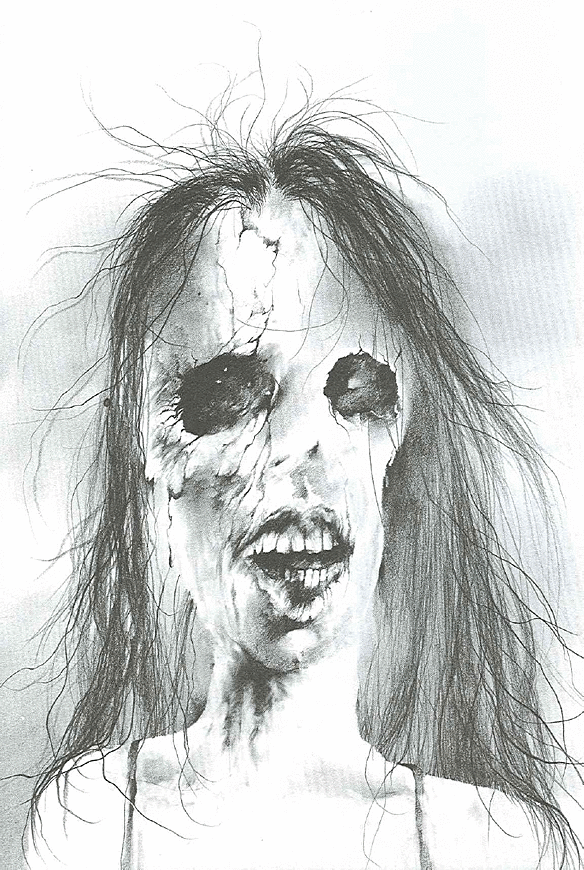
Decaying zombie face – Scary Stories to Tell in the Dark


That face. Just that face. Scary Stories to Tell in the Dark were a popular series of children’s horror books from about when I was a kid.  The stories in these books were usually corny, but the illustrations were the most disturbing part. And especially this one. A woman’s half-decayed face. Decaying corpses were a major phobia of mine as a kid, and still is. Can you believe this book was for children? Freaked me out. I don’t even really remember the story this illustration went with. This is all I remember. And that’s enough.


Charlie goes to Hell – All Dogs Go to Heaven


Don Bluth put so many kids in therapy when they were older. At least he didn’t sugarcoat his movies, but ye Gods. Did we need to see the main character descend into Hell and get eaten alive by little demonic puppy things? And that is why this is another movie I didn’t fully watch until I was older. At least An American Tail was just depressing, it never scared me out of my wits like this scene.


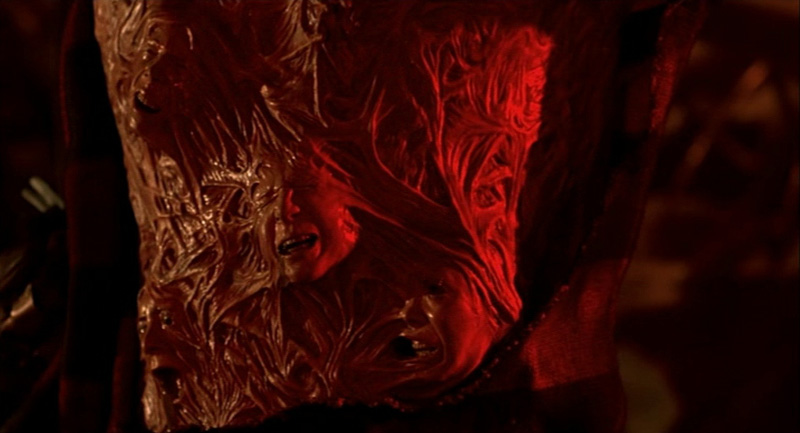
Freddy’s chest faces – A Nightmare on Elm Street 3: Dream Warriors


I was way too young to see this movie, but I remember channel surfing at age six or thereabouts, and coming across this scene. I didn’t even know what it was from until years later in my teens when I watched the third Nightmare on Elm Street movie and the memory came flooding back. I remembered seeing Freddy Krueger’s shirt ripped and there were these screaming faces in his chest, and it just terrified me as a kid. I changed the channel immediately, but I never forgot that image. What was this doing playing on TV during the day where some unsuspecting child could stumble upon it? I think my parents had HBO at some point for a brief time, maybe that was it. 


Trapped in a Painting – The Witches


This scene was unsettling for the concept. It has no jump scares, no monsters, no scary imagery. But the concept is what horrified me. Less a shock kind of scare and more an existential dread kind of scare. I fully understood the implications of this scene as a kid, and I didn’t like it. This part of the movie The Witches tells the story of a little girl who crossed a witch. The witch trapped her in a painting, and her grieving family got to watch her slowly grow older in the painting over the years, appearing in different spots each day and becoming an old lady, until one day, decades later, she was gone. The very idea of this scene was what scared me. What happened to the old woman? Where was she sent? Did she die alone in that cabin in the painting? 

Johnny 5 Gets Beaten Almost to Death – Short Circuit 2


I remember watching and enjoying the first Short Circuit film well enough. But the second one was something I had blocked out for a number of years due to a scene where the innocent, childlike living robot Johnny 5 gets beaten nearly to death by some thugs, all the while begging for his life. His human friend finds him in an alley, and when asked if he’s alright, he writes the word “dying” on the wall. Did they have to have this in the movie, really? Kids watched these movies!  I don’t even like thinking about this scene. 

2012 Apocalypse Prediction – Ancient Prophecies


People didn’t really talk about the 2012 Mayan Apocalypse Prediction until around 2008 or so, but I knew about it way back in 1997, thanks to the speculative documentary series Ancient Prophecies. As a kid I didn’t yet understand the concept of a “speculative” documentary, and figured if a documentary said something, then it must be true. So I believed all those prophecies, UFO and cryptozoology documentaries that even back then were all over the History Channel and the Discovery Channel. These prophecy shows are hilarious to watch now because of how wrong they turned out to be, but at the time, they filled me with angst about the future. In particular, the segment (about an hour and ten minutes in) about the Mayan prophecy insisted that on December 21, 2012, all of our technology will come to life and try to kill us. It happened to the Mayans, and it will happen to us next. “Imagine all of your household appliances getting a mind of their own, and deciding they don’t like you.” is the quote I remember. Images filled my mind of my Sega Genesis coming to life and trying to strangle me with its controller wires. I have never heard anyone else interpret the prophecy this way. Luckily, nothing happened. And I’ve learned not to believe everything claiming to be a “documentary “.
 

Leap Castle and “IT” - Castle Ghosts of Ireland


I saved the scariest for last. In the mid-1990s there was a speculative documentary series called Castle Ghosts, which discussed various ghost stories from castles around Ireland and the United Kingdom. The Ireland episode was the one that I never forgot. I only saw it once when it first aired, but when I finally saw it again almost twenty years later on YouTube, I remembered it perfectly. The first half of the episode is your typical spooky ghost documentary that’s not really scary. A World War I soldier haunts a castle he grew up in, a worker who died in an accident on the job haunts another castle. Eh. 

At about 34 minutes in, things go downhill fast, when they start talking about banshees. The screams in the documentary always creeped me out. But then, they discuss Leap Castle, one of the most screwed up, cursed locations on Earth. Here they discovered an oubliette in the wall. You might have heard the term oubliette from the movie Labyrinth. Real oubliettes were just deep pits with a big spike at the bottom. They threw you in to get impaled on the spike and bleed to death, and forgot about you. If you missed the spike, then you got to starve to death atop a pile of corpses and skeletons. It’s mentioned that when they finally cleaned out the oubliettes sometime in the early 1900s, long after they’d fallen out of use, they had to remove tons of bones and it took wheel barrel after wheel barrel to get them all out. Fun! Now if that had been all they said, that would have been enough. But no, there was a ghost involved. All of that collective negative energy from the people thrown into the oubliette manifested itself into an elemental ghost known only as “It”. (No relation to Pennywise the Clown.) It isn’t a proper ghost, just a being created by negativity. A tulpa, if you will. A woman in the castle once turned around and saw It, which looked like a rotting corpse with maggots in its eye sockets. They show this in the documentary as a dramatization, zooming in on the maggoty eye sockets. This scared the living hell out of me as a kid. More than anything else on this list. I would worry that It was in my closet or something. 

Anyway, that’s my list. There were probably more, but these stand out the most to me. What were some things that freaked you out as a kid, hm? You can tell me on Facebook, or write your own list.

Wednesday, January 1, 2020

My Top Picks From Public Domain Day!


                Hey you, yes you! Did you know that you are now the proud owner of all of the intellectual property from 1924? And so am I. And so is your next-door neighbor. And so is your ex from ten years ago. And so is that bully that used to give you wedgies back in 7th grade. (We mustn’t dwell upon them though, it’s been a long time and you should get over it.) Yes, Disney has allowed another year to slip through the cracks, so unless you live outside the United States and in a country with actual sane copyright laws where everything from 1924 went public domain decades ago, we’ve all finally got 1924 to work with. I don’t know how many more years Disney is going to allow this to go on. They’re obviously biding their time and playing a long game. Expect them to do something before Steamboat Willie gets on the copyright chopping block. Let’s just enjoy this while it lasts. And you should be enjoying this stuff. Take it. It’s yours. It’s ours. The big corporations don’t want us watching, reading, and enjoying this stuff. And they assume that we won’t, as long as they keep us distracted with their shiny new stuff. Don’t fall for it. And when The Man tries to stop anything from entering the public domain again, to take ownership for themselves our collective culture and heritage, fight them on it. Fight for your rights!

There’s a lot of books, movies, songs and art from 1924 I’ve never even heard of, but I plan on checking things out. I’ll tell you a few of the things I’m excited and proud to own the rights to now. And remember, you own them too!

Grampa in Oz by Ruth Plumly Thompson


            Oh goody, another Oz book! I get to be as excited as kids of the 1920’s, waiting for a new Oz book to come out every year. Except I’m too cheap/poor to actually pay money for something that I’m going to be able to get for free soon, so unlike those Roaring 20’s kids I’m waiting for the books to fall into the public domain one by one so I can catch them on Gutenberg.org. One day when I have enough money to throw around, I’ll get physical copies, I promise. Last year we got The Cowardly Lion of Oz. I plan on reviewing it eventually, but let’s just say I found it to be kind of like a bizarre fever dream. It had its moments, but I didn’t like that clown protagonist much. So, what’s this book going to be about? Someone’s grandfather ending up in Oz? Apparently not. You can read the summary on Wikipedia or the Oz Fandom Wiki. Sounds like another book where Thompson really wished she were writing her own original books, but since writing Oz books was the only gig she could get, she just shoehorned her story into Oz by introducing yet another previously-unmentioned micro-kingdom. To be fair, L. Frank Baum started doing this first (look at Rinkitink in Oz and The Scarecrow of Oz), so you can’t really fault Thompson for doing it too. Even though I’m working on my own Oz book (because public domain is so wonderful) it would be horrifying if those were the only books I was ever going to be allowed to write for the foreseeable future, since I’ve got my own original stories I want to eventually publish. From a writer's point of view, I understand why Thompson does this, and why Baum did it too. But Thompson usually does her best work when she’s using her own original characters, so maybe it’ll be one of her good ones. I haven't heard great things about this book from the Oz fans, but let me read and judge it for myself. Plus, we’re getting some John R. Neill illustrations as part of the deal that are going to be new to me, and are guaranteed to be good. Those are always the highlights and lighten up even the less-good Oz books.

            So, I wonder how on top of things people are going to be over at Gutenberg.org this year. I still had to wait about a month last year for The Cowardly Lion of Oz to get posted there. I don’t see that it’s been added yet, but it’s only January 1st. I just thought whoever posts up Oz ebooks on Gutenberg would have gotten the PDF ready ahead of time this year. I’ll have to keep checking.

The Dream by H.G. Wells


            I need to brush up on H.G. Wells, so I’ll probably be checking this book out when it goes up on Gutenberg, if I remind myself to do it. If I leave it in this blog, I’ll remember. I read The Time Machine and War of the Worlds when I was a kid, and found them very fascinating. This book deals with someone from a future Utopia dreaming of living in Victorian England, and apparently going back in time to do so. The grass is always greener, hm? I wonder if this visitor from the future discovers that the past isn’t all its cracked up to be. It’s probably going to be one of those stories. Although it’s been done since, this book would have been one of the first to have such a plotline I’d imagine. It sounds interesting to me.

Girl Shy and Hot Water, both starring Harold Lloyd


Yes! Harold Lloyd! I love his movies! He’s the hapless, somewhat nerdy everyman we can all identify with. I’m hoping my local historic theater, the Historic Cocoa Village Playhouse, will show these and other silent films now that they don’t have to pay anybody for them. That’s the true way to watch a silent film, in a theater with organ accompaniment. Something that should definitely be on your bucket list if you’ve never done that before.  Back when I lived in St. Petersburg, Florida, I went to the Tampa Theatre to watch Harold Lloyd’s Safety Last and had a great time. This was in the summer of 2018. But it’s just as well to put them on when you’re in the same room with someone who’s sleeping and it needs to be quiet, but you still want to watch something. This is when I usually put them on. When the wife and baby are asleep.

These have both been on YouTube for a while and I haven’t seen them yet, but now I’m going to set aside some time to do just that. I own them now by the way (and so does everyone) so it behooves me to do so. Funny how even though these just now entered the public domain these have been on YouTube for a few years, and no one bothered to take them down even though they were still copyrighted. Could it be that the mega-corporations that still own things from the 1920’s aren’t actually that bothered about protecting their copyright because old jazz music and silent films aren't very marketable or profitable (but they will still take you to court if you try to use it, just to make a few bucks), and this is why Disney and our other corporate overlords are allowing things to slip into the public domain for a few years until we get to the juicy stuff from the talkie era so that it at least looks like they’re throwing us a couple bones before they extend the copyright terms to forever and a day? Nah, I’m just being a crazy conspiracy theorist again, aren’t I?

The Navigator and Sherlock Jr., both starring Buster Keaton
 

I went on a Buster Keaton binge a few months ago actually, and wish I’d done it years ago. What a talented man. The only one who goes neck-to-neck with Charlie Chaplin and might actually have been better in a few ways. He does all his own insane stunts, so there’s that of course. I first saw Sherlock Jr. years ago on Turner Classic Movies, when I recorded it on a VHS tape for posterity, and I’ve watched it many times since. It’s one of my favorite silent movies, and now I own it. For some reason I thought it already was in the public domain. Well it’s been on YouTube for years, so it really might as well have been. And should have been. Now I can finally make that music video to Voltaire’s The Projectionist I’ve long wanted to make using clips from this movie. I just need video editing software, and Voltaire’s permission. Let’s work on getting the video editing software first (I do miss Windows Movie Maker). I need to see The Navigator again, by the way. I saw it once, many years ago. I’ve missed out on a lot of the longer silent films, I’ve realized. Whenever I’m in the mood for silent movies I tend to stick to shorts. Some of the longer ones I’m aware of I’ve watched maybe once if at all. But I’ll watch it. It’s on my YouTube playlist of silent films now.

Rhapsody in Blue


This is a nice relaxing song I’ve just now heard because I just checked it out while writing this blog. It’s a good piece of music. And it’s finally ours. I like to listen to jazz every now and again. I eagerly await someone to do a synthwave cover version now. Or a goth version. ”Rhapsody in Black”, mwahaha. Just listen to how old, crackly and grainy this recording sounds. It really shines a light on how ridiculously long copyright terms have gotten in the United States. My youngest grandparent, “Grandad” Dean Mann, was born in 1925, and he sadly passed in 2007. This is from the year before he was born and its finally just now public domain. For his entire life, and thirteen years later, this was copyrighted. Ridiculous. Oh finally, we get to own this little table scrap from the greedy billionaires. Thank you sir, may I have another? I think everything from at least before the 1960’s should be public domain by now. Maybe unless the creator is still alive and making a living on it. That’s how it would work in my world. Even that would be a compromise. Instead, movies where every actor, director, producer and staff member has long since died are owned by corporations that had nothing to do with creating the movie. Often times they just bought the rights from the corporation that actually funded it. Look at the 1939 adaptation of The Wizard of Oz for a prime example of that. Warner Bros. gets to go after people doing Oz adaptations for making the Wicked Witch of the West too green even though they had nothing to do with creating or even funding this 80-year-old movie.

Anyway, there’s a lot more where this came from. Quite a lot. Go ahead and look up all the literature, movies, songs and art from 1924. Wikipedia has lists. Go take what’s yours.

Tuesday, December 17, 2019

10 Favorite Oz Illustrations by John R. Neill

       
          L. Frank Baum formulated and put Oz into words first. W.W. Denslow did a very respectable job illustrating the first book, The Wonderful Wizard of Oz, and showing us what this land and its inhabitants look like. If you haven’t checked out what the original version of the book looked like, I suggest you have a gander for yourself over on Gutenberg.org. I’ll even give you a link. There’s nice use of color throughout the book; when Dorothy is in Munchkin Country everything is blue because that’s the dominant color there, then when she goes to the Emerald City and puts on those green spectacles the illustrations go green, and so on. It’s quite pretty.


However, Baum and Denslow ended up having a falling out of sorts, and as a result the next 35 Oz books were illustrated by one man, John R. Neill. Baum had initially planned there to be only 6 books, then financial trouble necessitated him to return for another 8, then he sadly died and the publishers hired Ruth Plumly Thompson to keep the series going. But with Neill’s illustrations as a constant, the transition was at least smoothed over somewhat. No disrespect to Denslow, but I prefer Neill’s artwork. He brought Oz to life in a way no other artist has. He helped teleport readers to Oz and escape their dreary lives. I even prefer his blonde Dorothy to Denslow’s stout, pigtailed redhead Dorothy. After writing even more Oz books than Baum, Thompson finally quit the series, and John R. Neill himself wrote some Oz books. These are something I still need to check out (they’re still under copyright and I’m always broke), but I hear they’re quite trippy, and chaotic. After Neill’s death, various others illustrated the Oz books, usually trying their best to replicate Neill’s style, but never quite duplicating it. Eric Shanower comes really close though.


I mentioned in my second blog post ever that I myself am working on my own Oz book. My plan, at least for the time being, is to try to self-illustrate the novel version. So, I have been studying Neill’s illustrations. I can’t quite draw like him yet; I have to insert something of my own style before it looks decent. Perhaps that’s for the best really, to stick to one’s own style. But I still want to have a go at it. If I completely fail, I suppose I can always hire an illustrator, with money I suppose I’ll have to get from somewhere.


For now, I’m just going to talk about ten illustrations of his I quite admire, but there are way more than just ten good ones. I’ll probably do a sequel blog one day with more.


We’ll start with my favorite picture of Ozma, Princess/Queen and ruler of Oz, which ought to look familiar to you if you caught my previous blog post about Oz. This picture is kind of an extra illustration, that appeared in Kabumpo in Oz, Ruth Plumly Thompson’s second Oz book. It doesn’t depict an actual scene in the story, it’s just a nice little portrait from the beginning of the book, before the story really starts. Neill can’t always decide how old he wants to make Ozma look in a lot of his illustrations; sometimes she looks like a little kid, sometimes a teen or even a grown woman. But this is the illustration where I think he truly captured what Ozma looks like; the beautiful fairy ruler of Oz with her big earmuff poppies, Oz logo tiara and crown, and flowing dark hair. To me, this is the true Ozma. Baum almost always spared a paragraph or two in his books to describe just how beautiful Ozma is and how much everyone in Oz loves her. You truly see that in this illustration. It’s a pity this portrait just kind of randomly appears in a later Oz book. It doesn’t get enough attention. I think it’s the best picture of Ozma anyone has ever drawn. This could have been cover art.


            Here we have Polychrome, the daughter of the Rainbow, in her first appearance in the 5th Oz book The Road to Oz. Every Neill illustration of Polychrome is pure gold, I could really have chosen any of them. I don’t know if I’d ever be able to draw like that. This illustration depicts how Dorothy, the Shaggy Man and Button-Bright first randomly encounter her on their journey, dancing away on the side of the road. Despite her merry dancing she is actually quite sad, because she’s fallen off the rainbow and can’t get back to her father, who is kind of like the God of Rainbows. She’s like a type of fairy or demigoddess. Anyway, the thing with The Road to Oz is, it’s kind of a bland book. There’s no central antagonist, the plot has no tension, it’s basically just Dorothy wandering with this homeless guy she meets outside her house known only as the Shaggy Man, and they encounter strange communities as they somewhat aimlessly follow the road before reaching Oz. They visit a city of humanoid foxes, a city of humanoid donkeys, and we get details like exactly what they ate for breakfast at whatever town they visit, things like that. It’s a fantasy travelogue. If you really love the chapter in The Wonderful Wizard of Oz where Dorothy and her friends visit the Dainty China Country where everything is made of porcelain, here’s a whole book like that. The book has its fans though, and it introduces some pretty important characters that reappear in later books so it’s not good to completely skip it. But making up for the rather uneventful plot, it has some of the best Neill illustrations ever. He is at the top of his game here. I read that he was compensating for the fact that it was to be the first Oz book without color illustrations, hence they’re extra lavish and detailed. 


          Now for a color picture. Here we have Scraps, the Patchwork Girl, merrily declaring her hatred for the concept of dignity in her debut, The Patchwork Girl of Oz. Not sure I agree with her, but it must be fun to not care about dignity. I think you have to throw a little bit of your dignity away to become a successful writer. If you want to actually make money doing it that is, and not be one of those snobby literary fiction writers who look down on science fiction and fantasy authors yet sell about ten copies of their boring book a year. It’s good to just write whatever it is you want to write, and not care what the critics have to say. Sometimes it's better to just turn off your censor. I have another blog entry coming on that subject. This illustration is from one of my favorite Oz books, by the way, and it has a few more great illustrations I’ll share here. Scraps is essentially a cotton-stuffed dummy made with a patchwork quilt who was brought to life via a magic powder. The protagonist, Ojo, sort of scrambled her brains before she was brought to life because he felt bad that she was essentially being created to be a house slave. Instead when she’s brought to life, she’s independent, poetic, energetic and sassy. One of the relatively few newly-introduced characters from this late in the series to become a mainstay hereafter, right up there with the likes of the Scarecrow, the Tin Woodman and Dorothy. Most other characters from the book are relegated to cameos when they do show up. Until Ruth Plumly Thompson gave Ojo his own book that is, but now we’re off topic.


            Here we have another random artwork from Kabumpo in Oz; once again this isn’t depicting a scene that actually happens in the story. This is Glinda, the Good Witch (or Sorceress, as it seems she’d rather be called in the sequels) of the South and ruler of Quadling Country, enjoying a little downtime by reading, well, Oz books. How meta. In the Oz universe, the books exist as true accounts that were told to Baum (and the later authors), the Royal Historian of Oz, usually by Dorothy, so that they could be published and shared in our world. After Baum lost contact with Oz at the end of the 6th book, he managed to contact Oz via wireless telegraph three years later, which allowed the series to continue (and I’m sure he was just thrilled to continue the series…nothing at all to do with financial problems…).  We’re never really told how Ruth Plumly Thompson, John R. Neill, Jack Snow or the others were getting their information from Oz. This gets to the point where later visitors to Oz from our world already know where they are because they read the previous books. Modern Oz authors who try to follow canon usually have their protagonists visiting from our world be much more familiar with the 1939 movie and have never even heard that there was a book series. Sadly, this is realistic. Anyway, I like this illustration for its subject matter. Best way to spend your day.   


            This is the header illustration from Chapter 19 of The Patchwork Girl of Oz where the gang meets up with Jack Pumpkinhead on their way to gather the magical ingredients needed to transform Ojo’s Unc Nunkie back from being accidentally turned to stone. He mainly features in The Marvelous Land of Oz, the 2nd Oz book, where he was created by the protagonist Tip out of some sticks and a large pumpkin, and the witch Mombi decides to test her Powder of Life out on him, bringing him to life. He worries that his head will spoil and that he’ll die. It almost sounds like he does get killed off at the end of the book, but Baum retconned this and brought him back. He now just replaces his heads when they spoil. Thompson gave him his own book later on where he was a main character, but in the other books he mainly just shows up for a chapter when the characters visit him in his giant pumpkin house on a pumpkin patch, and he points them in the right direction or just makes them some pumpkin pie. He’s so fashionable here in this illustration. Anyway, I have one more illustration I want to share of him. Most illustrations of Jack are just fun to look at, but check this next one out:


            Wow Neill, way to make a lovable character look like a murderous, psychopathic serial killer! Are these the heads of his victims? Is he ensuring that he is the only pumpkinhead in Oz? In actuality, this depicts him carving his own replacement head, and being a perfectionist, throwing away the ones he made a small mistake on. Still pretty macabre though. I love morbid things, so this illustration amuses me.  


            So these sketches come from Handy Mandy in Oz, my absolute favorite Ruth Plumly Thompson book. Mandy is a seven-armed goat herder who ends up shot through the air via a geyser and landing in Oz. Mandy is strong, sassy, and doesn’t take lip from anyone. She completely carries that book with her personality alone. It doesn’t matter to me if the villain’s plot (stealing the most powerful magic artifacts of Oz) has been done before in a previous Oz book (Baum’s The Lost Princess of Oz), nor that everything’s solved via contrived deus ex machina. Seeing Mandy and her interactions with the much more serious Nox the Ox, and the way their personalities bounce off one another but they develop a strong bond, makes reading and re-reading the book worth it. And she’s such a unique character. In no way is she "disabled". She uses her arms to her full advantage. In her mind, she’s the normal one, everyone else is a disabled weirdo for having only two arms. Haven’t you ever wished for more than two arms? If not, become a parent sometime. You will. Now I just love these sketches because you can see that Neill was practicing having to draw a seven-armed goat herder; not an easy task. None of these scenes happen in the book. They’re just Mandy in different poses. Almost like a model sheet. It reminds me of how the inside of my sketchbooks end up looking when I’m designing a character. We get Scarecrow and Scraps as a little cameo too. 


            And here we have Woot the Wanderer, a young vagabond appearing in the book The Tin Woodman of Oz who got bored one day and just decided to explore Oz for the rest of his life, gratefully drinking a gigantic cup of coffee offered to him by a giant witch (who later transforms him into a green monkey against his will; a signature trope in Oz books by the way, someone getting transformed against their will). This would make a perfect “When you…” meme. It’s me after a night of insomnia. 

Woot is such a wasted character, by the way. He only ever appears in this one book. I’m not aware of any modern Oz books that really utilize him either. 


            I know this illustration is marred by a page break in the middle, but just try to overlook that for a moment and appreciate how badass this illustration is. This is Princess Planetty of Anuther Planet from The Silver Princess in Oz by Ruth Plumly Thompson, escaping her homeworld on her black steed, galloping through the void of space only to land in the Land of Ix, one of Oz’s neighboring countries. So, we get some sci-fi mixed with our fantasy here. Neill must have had a blast drawing this character because she gets tons of illustrations throughout the book, and they’re all really good. But there is, unfortunately, a big elephant in the room when it comes to this book, and it's not Kabumpo. It’s only too bad that the second half of this book is one of the most racist things you’ll ever read. Planetty, Kabumpo the elephant, and Prince Randy of Regalia (one of Oz’s semi-autonomous micronations) help put down a slave rebellion and rescue the slave-owner, depicted as a “good guy”, Jinnicky the Red Jinn (a character I hate not only for being a racist slave-owner, but also for always ruining good plots with his deus ex machina, but that’s besides the point really). And the illustrations for this part are quite racist too. It really makes Huckleberry Finn look progressive by comparison. So, while the first half of the book is actually pretty good, or at least the characters are interesting and they interact well, it gets ruined. Planetty is a cool character, it’s just too bad she’s in this book. It made me sad when I first read it. Read this one with utmost caution; it is public domain, you can find it on Gutenberg if you're curious. It’s still a badass illustration though, right? Just look at the skill with which this illustration was drawn.


So yes, back to The Patchwork Girl of Oz. This is the last illustration in the book, where Ojo, after enduring a long, difficult and at times seemingly hopeless journey, full of hardships, finally succeeds in saving his beloved Unc Nunkie from being turned to stone, and they have a loving embrace. It’s almost like the end of An American Tail when Fievel finally reunites with his family. Awwww. I have something in my eye now. I’m not crying, you’re crying. It’s such a satisfying end to the book, that you won’t really get if you’re reading an edition of the book without Neill’s illustrations. There’s so much heart put into this. I love how Ojo has to stand on his tip-toes while Unc Nunkie has to crouch a bit for them to hug, Ojo losing his hat in the moment. You just see the father-son love between them both. It’s little details like that which make a good illustration. It not only compliments but completes the narrative. Baum doesn’t really go into a lot of detail about this particular moment, but seeing it is worth a thousand words. In short, this illustration made the story even better.

Anyway, that’s ten illustrations. Let’s do this again sometime. Next time I talk about Oz on here, it will probably be the book reviews. Probably. I don’t really know what I’m doing day-to-day on this blog. I came up for the idea for today's blog entry last night at 4am while suffering insomnia, and watching the silent movie adaptation of The Patchwork Girl of Oz to goth music. Fun times.