Showing posts with label Ruth Plumly Thompson. Show all posts

Wednesday, May 26, 2021

Thoughts on “Ojo in Oz”


I’ve still been plodding my way through the Thompson Oz books. Some I feel like I don’t have a lot to say about, but I’ll briefly give some thoughts on the books I’ve read since The Lost King of Oz. 


The Giant Horse of Oz was okay. I find the title a bit baffling because the titular horse doesn’t appear until many chapters in and is not the main focus of the book at all, but that does happen in this series from time to time. I did wonder how the Munchkins and Gillikins felt about Ozma haphazardly assigning monarchs who she just met to their countries. Like “hey, you seem like a nice guy, here, rule one fourth of Oz.” Surely Ozma could have found better rulers than some guy she’s known for five minutes. I don’t think Thompson really goes anywhere with the characters Joe King (King of Gilliken Country) and King Cheeriobed (King of Munchkin Country) in subsequent books either. They show up at Ozma’s parties, that’s about it.


I didn’t like The Yellow Knight of Oz, partly because I just wasn’t ever invested in the character, and it seemed like just one event after another without much of a point. Like The Road to Oz, it was almost just a travelogue with not much at stake. The knight sets off on his journey because he’s bored rather than for any special reason, and he tours the often pun-based gimmicky communities of Oz. As Handy Mandy in Oz showed, even having a likable, well-rounded yet flawed main character can be enough to save a book with kind of a cliche and predictable plot, but the Yellow Knight was not a character like that, to me at least. 


And lastly I read Pirates in Oz, which kind of like Baum’s Rinkitink in Oz was only barely an Oz book, with 98 percent of it taking place outside Oz. I actually liked this book too, and I shall need to give the public domain direct sequel Captain Salt in Oz a read now that I’ve familiarized myself with its predecessor. Thompson’s character Peter, who visits Oz from America in a few books, has a little more personality in this book than the blank slate, audience surrogate he seemed to be in Jack Pumpkinhead of Oz.


Which gets me to the next book I read, Ojo in Oz. 


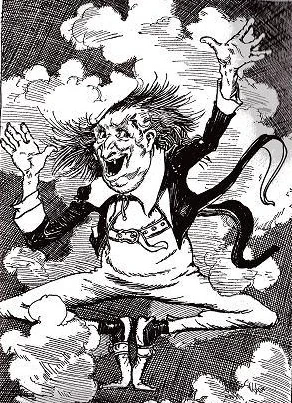
Nice hourglass figure, Ojo.


Overall, despite a few flaws I thought this was one of the better Thompson books, actually. I had heard mixed things about it. Working on an Oz book of my own in which Ojo is a character, I had long felt the need to familiarize myself with this book, although it is still under copyright and I couldn’t include anything directly from it legally anyway. It’s still canon. I can see why the modern Oz authors I’ve talked to tend to hate this book because its ending kind of limits Ojo’s storytelling potential, since (spoiler alert) he moves to Seebania to live with his newfound parents. Even Jack Snow, an official author of the Famous Forty, decided to retcon it and have Ojo and Unc Nunkie living back in their cottage outside the Emerald City as if Ojo in Oz had never happened. Its ending is going to force me to change my story around as well, that is, depending on how I publish it (if I’m self-publishing I will ignore this book too, if only for legal reasons). I think I can still work with it if I bend and twist the plot around, it’s not enough to completely sink my story. I may also have to work in other modern Oz stories I haven’t read yet to make it fit in with the Oz Timeline, making this story the least of my problems.


Anyway, back to the book. The first thing I would like to discuss is the title itself. Ojo IN Oz. It should have been Ojo of Oz. The titles of Oz books generally follow a formula, besides the odd titles like The Road to Oz and Ozoplaning with the Wizard of Oz. There isn’t always a character in the title (The Marvelous Land of Oz, The Emerald City of Oz), but when there is and the title character is a native of Oz, the formula is “((character name)) of Oz”. If the title character is from outside of Oz and visits Oz, the formula is “((character name)) in Oz”. Ojo is a native of Oz. Why then, is it Ojo IN Oz? Of course he’s in Oz, he’s never left Oz. The “in” makes it sound like he’s just visiting Oz. He’s a citizen of Oz. OF OZ. Ozma of Oz, Tik Tok of Oz, The Patchwork Girl of Oz, The Scarecrow of Oz, Glinda of Oz. They’re all of Oz, because they live there. Come to think of it, now that I’m looking at a list of the Famous Forty, two other books also have this problem, and both are Thompson books; Kabumpo in Oz and Grampa in Oz. Both title characters are Oz natives. It annoys me. It’s probably the publisher’s fault. Anyway, enough on that, it’s just a pet peeve.


The second thing I should discuss, and this story is fairly notorious for this, is the unfortunate racism. Yes yes, Baum could be racist too on occasion, and it was the 1930s, people didn’t know any better, but that’s less an excuse and more just an explanation. At the beginning of the story, Ojo is kidnapped by Gypsies, now widely known by the more politically correct name Romani. It is never explained why there is a group of Romani in Oz. Now Thompson could have easily replaced them with whatever fictional gimmicky group of Ozians she wanted and it would have been fine, but she had to go and needlessly vilify an ethnic group from the real world, in a way that makes zero sense in the context of the Oz series. I know attitudes were different in the 1930s, and this is far from the only negative depiction of Romani people in literature and media even going into recent decades, but I guess what irritates me about it most is how easily avoidable this could have been by simply replacing them with a fictional group of people native to Oz. It would both make more sense and be less racist. At the end of the book Ozma sends them back to Europe, and it’s the 1930s. Yikes. Not that Thompson would have known what was to happen in a few years. Thompson was merely a product of her environment. This book gives us a glimpse into the mentality that led to the genocide of Romani during World War II. 


Moving onto more pleasant topics, this book contains in it one of the most unintentionally hilarious chapters ever in an Oz book. Now it’s best read if you dumb your sense of humor down to the maturity of a 12 year old, which fortunately I can do on command. When Dorothy, Scraps and the Cowardly Lion are searching for Ojo, one of the towns they visit is a place called Dicksyland. Dicksyland is populated by the “queer” Dicks. Some Dicks are described as short and fat, others thin and handsome. Their leader, Dickus the Third, the Dicktator of Dicksyland, has a “Right Hand Man” (I guess the Left Hand Man was fired, he just didn’t have as good of a grip on his job). The innuendos go on; the fact that “dick” already had its current slang meaning in the 1930s makes one wonder if Thompson knew. Was she a pure and innocent children’s book author, or could it be that she was somehow privy to obscene locker room jargon of the day and wanted to see how much her publisher would let her get away with? The world may never know.


“The Second Dick was short and fat.” HAHAHA yeah I know I’m immature.

In all, while I appreciate the effort Thompson often put in to revive some of Baum’s more forgotten characters (it always bugged me how Scraps just kind of stopped hanging out with Ojo after becoming a favorite at the palace, despite their previously close friendship, and he became relegated to mere cameos from then on), she unknowingly and unintentionally threw a monkey wrench into the stories of Oz authors for decades to come by taking Ojo in her own drastic direction. It’s similar to how she did her own thing with the Scarecrow’s backstory. Not that I really blame her for it, she was the Royal Historian after all, given free reign over Oz by the publisher, and the only more legitimate source on Oz canon than her is Baum himself. To be fair, Unc Nunkie and Ojo always had being former royals as part of their backstory, as Baum mentions Unc Nunkie could have been king of the Munchkins had Ozma not ascended to the throne. It just so happened that characters turning out to be royalty was one of Thompson’s favorite plot twists, so it almost seems like something she made up herself. Plenty of royals to go around in Oz when their towns seem to have kings and queens instead of mayors. At least Ojo’s dad, the lovable rogue Realbad, is a pretty cool guy and a well-rounded character. His mom could have used some characterization though.


 In any case, Ojo later moved back to the Emerald City to be roommates with Button-Bright in modern post-Famous Forty canon, so there.

Wednesday, February 24, 2021

Fun, Time-Wasting Character Charts

 I have been lurking around in the Fire Emblem community for a couple months now; despite being a fan of the games for many years, for some reason it never occurred to me to seek out its fandom until recently. This may have to do with the fact that before the most recent game, Fire Emblem: Three Houses, became a hit, the fandom was significantly smaller. In any case, I started seeing character charts being shared around such as this: 


This one is for Fire Emblem: Radiant Dawn, a title for the Nintendo Wii. Having played the game, the chart is mostly accurate. Although, that bald overweight guy under Chaotic Angry ought to be under Chaotic Horny if you ask me, as he is quite lecherous. He is a slave trader who has Reyson, a member of the angel-like Serenes species who you see under Angry Angry (his anger comes from being one of three survivors of a genocide against his species, so it’s very understandable), kidnapped, and then proceeds to fawn over him in a suggestive manner. You get the feeling he has a fetish for the Serenes. Why they gave this gross character the coolest theme in the game I don’t know. This all happens in the prequel to this game, Fire Emblem: Path of Radiance, by the way. In Radiant Dawn, despite him pretty clearly dying in the previous game, they bring him back with no explanation and he becomes a good guy. That game seems like it was written by completely different people as it ruins the characterizations of a lot of characters from the previous one. I don’t forgive Oliver for being a disgusting, perverted slave-holder, but the game expects you to. 


These have been made for basically all of the Fire Emblem games. But I decided to make one myself, not for Fire Emblem, but for the Oz series. With forty books, the series contains hundreds of characters. Certainly making such a chart would be no problem, right? So I got the template first:


Have fun with this. 

I grabbed an already done chart and erased the Fire Emblem characters in the Comic Draw program I use for my webcomic (follow the shameless plug). Next, I needed to compile a list. This was difficult, especially since there aren’t many “horny” characters in the Oz books. But I managed, by digging up some more obscure ones. Finding corresponding illustrations was usually quite easy thanks to the Oz Fandom Wiki and Project Gutenberg, but challenging at times if they weren’t from one of the public domain books. All are by John R. Neill save for the Wicked Witch of the West, by W.W. Denslow. Here’s the chart, and a list of characters with explanations. 


Pure Pure: Dorothy - Plenty of characters would fit in this category; Ozma, Glinda, Betsy, Ojo, etc. I went with Dorothy due to her prominence in the earlier and more famous Oz books. 


Pure Angry: Queen Ann - Angry at her status as queen of an irrelevant kingdom in Oz, but harmless overall. 


Pure Horny: Tin Woodman - He was horny when he was Nick Chopper, before he became tin. And he’s pure-hearted. 


Pure Stupid: The Scarecrow - He does get smarter over the course of the books, but that brain the Wizard gave him was a total placebo. It gave him confidence, not intelligence. But his lack of intelligence in the early books may just stem from the fact that he was inexperienced, having come to life not long before Dorothy discovered him. He was never as stupid as he thought he was in the first book, but never as smart as he thought he was in the other books.


Pure Chaotic: Scraps - Scraps is unpredictable, but pure-hearted. Her innocence can lead her to be unknowingly mean occasionally, but that’s the chaos. 


Angry Pure: Woozy - He gets inexplicably furious when you say the words krizzle-kroo. But otherwise is calm-tempered and benevolent.


Angry Angry: Ruggedo - This is the former Nome King’s defining character trait. He never gets over losing his Magic Belt, and later his throne, thanks to the meddling of Ozma and her friends. 


Angry Horny: Googly-Goo - A noble from the kingdom of Jinxland who tries to force Princess Gloria to marry him, when she has eyes for the gardener Pon. 


Angry Stupid: Jinjur - Angry over Oz’s patriarchy, she managed to take over Oz with an army of women wielding sewing needles, but had no plan for what to do after taking the throne. Leading to her quick defeat.


Angry Chaotic: Wicked Witch of the West - The most well-known villain of the series. She has all sorts of tricks up her sleeves, so you don’t know what she will do next. She’s also very angry.


Horny Pure: Jo Files - A member of Queen Ann’s army who falls in love with a Rose Princess named Ozga. The romance is rushed and undeveloped, but writing love stories in the Oz series wasn’t Baum’s strong suit. Maybe he had better love stories in his adult novels, I’m not sure. I need to read them.


Horny Angry: Nimmie Amee - Her anger is understandable when both her boyfriends were gradually dismembered and replaced with tin parts, and eventually abandoned her. The Tin Woodman in particular could have sought her out a lot sooner than he did. Her anger is justified.


Horny Horny: Captain Fyter - Nimmie’s other ex-boyfriend. There’s not much more to his character than this, making horny his only real trait.


Horny Stupid: Chopfyt - Nimmie’s current boyfriend, a Frankenstein monster made up of Nick Chopper and Captain Fyter’s discarded body parts. Not much going on in his brain.


Horny Chaotic: Mogodore the Mighty - From Jack Pumpkinhead of Oz, this villainous baron first tries to force Princess Shirley Sunshine to marry him, but after he conquers the Emerald City in an embarrassingly low moment for Ozma’s rule (he conquered it while everyone was playing Blind Man’s Bluff and was blindfolded), he decides to force Ozma to marry him instead. Took some serious digging to get that illustration by the way, since his book is still under copyright. You’re welcome. 


Stupid Pure: Jack Pumpkinhead - He often admits to being dim-witted, but that comes with having a pumpkin for a head. He did defeat Mogodore, though. 


Stupid Angry: The Mangaboos - Pictured is Gwig, their sorcerer, but the subterranean Mangaboos are plant people that are hostile to outsiders, and not too bright. This could also apply to any number of Oz’s small kingdoms visited in filler chapters. 


Stupid Horny: Princess Gloria - She’s in love with a gardener named Pon, but is just a damsel in distress. 


Stupid Stupid: Button-Bright - Particularly in his first appearance, where all he ever says is “Don’t know”. Dorothy calls him stupid at one point. He gets wiser in later books. 


Stupid Chaotic: Notta Bit More - A bungling clown from The Cowardly Lion of Oz who refuses to change his strategy in dealing with threats no matter how many times his strategy fails. He’s chaotic in the same way Scraps is. You would have to be chaotic to accidentally stumble upon a nonsense spell that sends one to Oz.


Chaotic Pure: Handy Mandy - A seven-armed goat herder who doesn’t take smack from anyone. Her temper can provoke Oz’s stupid-angry filler kingdoms, but she’s got a heart of gold and ends up saving Oz. 


Chaotic Angry: Mombi - Another wicked witch. Her bitterness may stem from the fact that she never got to become the Wicked Witch of the North. 


Chaotic Horny: Glegg - A creeper from Kabumpo in Oz who wouldn’t take no for an answer when Princess Peg Amy rejected him, so he turned her into a tree. Another victim of Ruth Plumly Thompson’s bloodthirsty version of Ozma, he was actually executed by being made to drink one of his own potions. That illustration of him is hilarious, by the way. 


Chaotic Stupid: The Whimsies - A malicious race of beings with tiny heads that leave little room for brains. The Nome King recruited them to help invade Oz one time. 


Chaotic Chaotic: The First and Foremost - He is actually the most powerful and feared villain in the Oz series, as the most powerful of the Phanfasms, another malicious race that the Nome King recruited for his invasion of Oz. They agreed to join because they like to make people suffer. 


Anyway, that’s the list. Since most Oz books have no romance, the Horny section includes basically any character who ever showed interest in romance at any point. Baum avoided romance most of the time, while Thompson basically told the same love story over and over, and the characters tended to fall under Pure Horny in every case. Notably I couldn’t find anyplace to put The Wizard or the Cowardly Lion. They just don’t seem to fall under any of these categories. There needed to be a cowardly and a shady column for them.


Monday, December 21, 2020

Thoughts on The Lost King of Oz - Wasted Opportunities and Casual Executions


Oz books are always a great distraction from the real world. As is critiquing them. On the eve of its falling into the public domain on January 1st, I finally read The Lost King of Oz, the 19th volume of the Famous Forty Oz books, and fifth book by Ruth Plumly Thompson. Like it or not this book is a pivotal one in the series; it features the return of Mombi, not seen since the 2nd book The Marvelous Land of Oz, and the return of the titular King of Oz, Pastoria, who went missing long before the events of the first book. When she inherited the Oz series, Thompson ran things as she saw fit. She wasn’t afraid of shaking things up in Oz. She started by giving the Scarecrow a backstory (which falls apart under closer scrutiny), and soon Oz was gaining new independent kingdoms left and right (it’s as if towns and mayors don’t exist in Oz, every little town has to be its own gimmicky little kingdom), and new mainstay characters like Kabumpo the Elephant and the Yellow Knight. Ozma was a lot less of a pacifist, as we’ll see in this book, and eventually makes Oz a colonial power, quite contrary to the first 14 books. Later writers would be more careful with Oz canon, not wanting to contradict anything Baum wrote, unless deliberately doing their own thing with Oz like Wicked and Dorothy Must Die. But Thompson did as she wished. She did things her own way. No one stopped her, it would seem. She had official backing from the publisher and the go-ahead from Maud Baum, L. Frank Baum’s widow, giving her a level of legitimacy no modern Oz writer will ever have, and this emboldened her. 


There are some that really love her books, and there are some that really hate them. But I think most Oz book fans agree that they were pretty hit-or-miss. I think at least some of the criticisms leveled at her are unfair at times; after all, L. Frank Baum also liked to introduce new kingdoms and characters, and forget them just as easily in the next book. Baum too would occasionally decide he wanted to focus on original characters and leave the main characters as mere cameos. His books were also filled with encounters with gimmicky communities that distracted from the main plot. Baum also liked puns almost as much as Thompson did. Even though Thompson didn’t always follow canon, sometimes Baum contradicted his own canon. If someone’s main criticism of Thompson is the racism in some of her books, then I won’t blame them one bit. I don’t like that either. But I think some people don’t like her just because she’s not Baum, overlooking flaws in Baum’s stories while criticizing Thompson for doing the same things he did. As for me, I suppose I’m just pretty forgiving in general when it comes to Oz books because I have a soft spot for them. I fall squarely into the “hit-or-miss” camp when it comes to Thompson. I can see where her detractors are coming from, but I recognize she deserves credit for keeping the series going, and for those of us writing our own Oz stories, she really paved the way. No one’s going to see and interpret Oz exactly like Baum did. Thompson was the first one to interpret Oz in their own unique way after its creator passed away, and any later writer of Oz stories owes her a debt for that. Do I always like her interpretation of Oz, though? No, not always.


With all that said, I have mixed feelings about The Lost King of Oz. Spoilers ahead, by the way.


The main character of the book is Mombi, who is also the main villain. For some reason Thompson seems to have a special hatred for Mombi, since she extended Mombi’s rap sheet and elevated her to be even more evil than she was originally. Even after this book, Mombi gets blamed for new things that happened before Dorothy’s arrival in Oz which were unmentioned by Baum (I’m currently reading The Giant Horse of Oz, which does exactly this). In addition to kidnapping Ozma and switching her gender, she erased King Pastoria’s memory and turned his Prime Minister into a goose. This goose turns up at her new workplace, a kitchen for King Kinda Jolly (take a second to groan at the name), in the small kingdom of Kimbaloo in Gillikin Country (or “Gilliken” as Thompson insists on spelling it for some reason). The goose, Pajuka, is on the menu, despite Oz being a vegan fairyland where “meat” grows on trees, and where all animals have human-level intelligence and talk. Evidently the barbaric residents of Kimbaloo are still carnivorous despite this. Anyway, upon being reunited with the former Prime Minister, Mombi comes up with a somewhat convoluted plan to find King Pastoria and use him to regain her powers and take over the Emerald City. I don’t know how she thought Glinda, Ozma and the Wizard would simply stand by and allow a powerless former witch to take over Oz, but evidently she didn’t think that far ahead. She kidnaps a boy who overheard her evil scheme, Snip the Button Boy (in addition to being one of the last Oz kingdoms to still murder sentient animals for meat when they could literally find a tree that grows fried chicken if they wanted to, Kimbaloo’s main export is buttons, hence Snip the Button Boy whose clothes is covered in buttons), and forces him to be her pack mule on the long journey. They encounter some forgettable Wacky Wayside Tribes along the way which pad the book out and make it longer.


Eight whole chapters in we finally get our secondary plot (suddenly introducing a subplot almost halfway through the book is a thing Baum did as well), in which Ozma and her friends are given a clue about Pastoria and set out to find him. Before they get the clue we learn that Dorothy has gone off to visit some friends, leaving Ozma sad and lonely. I am glad Thompson preserved their chemistry, and never decided to pair Ozma up with some random prince or something. As you know if you’re familiar with the series, Ozma probably really isn’t into princes, if you catch my drift. Overall their subplot isn’t terribly significant to the main plot. And in chapter 10 we get a third subplot featuring Dorothy Gale. And let me tell you, the wasted opportunities in her subplot make me angrier the more I think about it. After visiting some characters from the previous book Grampa in Oz, she stumbles upon a very convenient Wish Way, a dirt road where your wishes come true if you speak them aloud. Thompson used this plot device in her first Oz book. There are at least two Wish Ways in Oz that we know about. It’s interesting to think of how previous books would have been different if people had known about the Wish Way. Dorothy could have wished herself back to Kansas in the first book, Jinjur could have conquered Oz using it, Ozma could have gone there and simply wished for Ev’s royalty to be freed from the Nome King without having to travel to Ev, Ojo could have wished his uncle not to be turned to stone anymore. There wouldn’t be an Oz series anymore, really. I mean maybe if the Wish Way randomly changed locations periodically it might make for a good occasional plot device, but having it always be in the same spot and not be widely known about and never be used by anyone until they stumble upon it is a little unbelievable. (In my planned Oz book, it’s protected by spells and largely obscure, but Ozites can still find out about it if they read the Oz histories).


Anyway, Dorothy accidentally wishes herself back to America, where she appears at the set of a movie somewhere not far from Hollywood, California (I pictured the whole thing taking place at Kirk’s Rock). After a bit she begins to rapidly age into an adult woman, her true age in 1925 if she had stayed in America. So according to Famous Forty canon, this is what happens when someone from the Outside World travels to Oz and stops aging, and then comes back. If it were to happen in a modern story Dorothy would age to nearly 130 years old and likely die. All of the characters who immigrated to Oz from the Outside World are essentially trapped there now. This makes me question the story in The Lost Tales of Oz, The Wizard in New York by Sam Sackett, where the Wizard of Oz, Oscar Diggs, goes to the 1939 World Fair in New York. Why didn’t he age to 100 or however old he would be in 1939? Of course, it’s up to the reader whether they want to consider modern Oz pastiches canon or not. I like to, just for fun. But surely they could have come up with some magical prevention spell to keep the Wizard from aging, as a nod to what happened to Dorothy when she went back to America. Perhaps the author could be forgiven for forgetting about this chapter in The Lost King of Oz, because Thompson treats it as forgettable. Or maybe it was avoided because the book was still under copyright, I don’t know.


To sum the rest of this chapter up (yes...this one chapter), she accidentally wishes a stunt dummy to life, and wishes herself back to Oz, where she ages back down to a child. What a wasted plot. There could have been an entire book about Dorothy accidentally wishing herself to America and trying to get back to Oz. It could have been a clever inverse to the first Oz book, especially at this late point in the series where Oz is very much Dorothy’s home. It could have been called “There’s No Place Like Oz”. I want to read that book. But no, instead it’s another single-chapter-long, quickly forgotten misadventure just like the other chapters that have the characters visit some bizarre gimmick community, and the only way it impacts the plot at all is to introduce Humpy the stunt dummy. A character who could have been left out of the story altogether without the plot changing much. Another annoyance in this chapter is the line Thompson slips in during Dorothy’s ordeal, “as she afterwards explained to Sir Hokus of Pokes”, indicating Dorothy will get back to Oz and tell the story to her friend the Sir Hokus the Yellow Knight, before it is revealed how she gets back. I mean of course she’ll get back, but way to just remove what little sense of suspense there still was in this episode. I hate when authors spoil their own story like that, it’s a pet peeve of mine. It takes you right out of the story. Wouldn’t want to scare the kids reading by having even an ounce of suspense in the story now would we? Those few words destroyed the entire subplot. Dorothy’s return to America was not treated as importantly as it should have been. This idea with so much potential was wasted just so Thompson could shoehorn this living stunt dummy into the story that didn’t need to be there!


I need to remind myself that there are more important things to be angry at than 95-year-old fantasy stories written for kids. Sigh.


So eventually Mombi gets sick of Snip knowing too much about her plan and throws him down a well, which very conveniently leads Snip to a tailor, Tora, who has been imprisoned by invisible people called the Blanks. This tailor has lost his memory. Hmm, I wonder who he could be? They escape, and rendezvous with Dorothy and the dummy, who have been joined by Kabumpo the elephant, and eventually they meet Mombi. They all come to the conclusion that Humpy the dummy who was just brought to life in America MUST be the lost king, because classism blinds them to the idea that the king might be an amnesiac tailor. Kabumpo even entertains the idea of not allowing Tora to enter the palace because he’s a lowly peasant. Maybe Thompson was trying to make a statement against classism and snobbery here, but reading her other books, I still think she was a lot more classist than Baum. Another example of this is the conspicuous absence of everyone’s favorite and totally not creepy hobo the Shaggy Man from her books. And the fact that just about every book of hers stars royalty or at least has royals as major characters at some point.


Anyway, once the king is revealed at the end of the book, he does not force Ozma to abdicate the throne as some feared, but wishes to continue on as a tailor and let his daughter rule. Thompson could have shaken things up in Oz by having Pastoria take the throne, she had the power to make a decision like that, but she wisely chose not to and kept the status quo going. Fiction needs more strong female rulers, even moreso back in the 1920s, so I think it was the right choice. What’s more debated is the decision for Ozma to order Mombi’s execution via being splashed with water like the Wicked Witch of the West (this was never stated to be the weakness of every witch in Oz). Yes, it would seem Mombi’s attempt to take over Oz was what crossed the line, causing Ozma to break her pacifism. And what’s more, it was meek little Dorothy’s idea to kill her with water. Dorothy, who never killed anyone on purpose before. Now I had already had the ending spoiled for me before I read the book, and was expecting at least an entire chapter devoted to this dramatic event, during which Ozma struggled with the decision, but when I finally read it, I was shocked by how casual and nonchalant the whole thing was. Dorothy and Ozma’s quick decision to kill her to the aftermath of the deed take up barely more than a page in the last chapter. 


Ahem...

Whatever happened to the Ozma who, in The Emerald City of Oz, refused to resort to a violent reaction when Oz was being invaded, declaring “No one has the right to destroy any living creatures, no matter how evil they may be, or to hurt them or make them unhappy. I will not fight - even to save my kingdom”?  (Aw, you’re making me feel guilty every time I kill a mosquito or cockroach now, Ozma.) Does this sound like the type of person who, when asked if Mombi should be killed, would shrug and reply “Eh, okay.” This is basically what actually happened in the book. Was she replaced by one of Jack Snow’s magical mimics? What happened to Ozma? Well, Thompson happened. She had drastically different ideologies from L. Frank Baum. I bet if she had written the first book, Dorothy would have killed the Wicked Witch of the West on purpose, and would have started moving stuff around in her house as it was falling to aim it at the Wicked Witch of the East.


Part of what got me glued to the Oz series as an adult was L. Frank Baum’s ideology, and Oz being a classless, moneyless and nonviolent fairyland where those who were different were welcomed. The polar opposite of this world. This is all sadly lacking in Thompson’s books. But, some part of me still likes at least some of her books. Handy Mandy in Oz for instance, is my favorite of hers, thanks more to the characters than the plot. Kabumpo in Oz is my second favorite Thompson Oz book, both because of the characters and because it had a plot that kept me guessing what would happen next. I guess what keeps me coming back to Ruth Plumly Thompson is Oz itself, and its characters. And it’s comforting to know there are so many Oz books out there I probably won’t ever run out of them. There’s always going to be another that I haven’t read. So, even if it’s something I’m going to end up heavily criticizing, I still enjoy reading Oz books, if only to escape the real world for a while.


Special thanks to my friend Paul Dana for the book! Otherwise I would have had to wait a few months for it to finally show up on Gutenberg, as it will be public domain in 2021. 

Friday, November 20, 2020

Alternate Titles to L. Frank Baum’s Oz Books


Titles are hard. Sometimes they’re the hardest part of a story. And you might go through several working titles before settling on one. I know this only too well, as a writer. And then even when you think you have the best title, your publisher could decide otherwise.

In the Facebook group Yellow Book Road: The Literary World of Oz, a contest was born out of a discussion I myself participated in, although Paul Dana deserves credit for the idea. The topic of the sometimes misleading titles to Oz books came up. Why is, for instance, The Scarecrow of Oz named after a character who doesn’t show up until two thirds of the way through the book? Tik-Tok of Oz has a similar issue, where the titular character is rather minor in the overall story, and isn’t present from the beginning. Even the very first book, whose title is so iconic, could be argued to have the same issue. The obvious answer of course is that either the author or the publisher thought the titles would sell more books. But in some cases, it amounts to false advertising. No one really seems to know a lot about Baum’s preferred titles, save for the first book which was originally going to be called The Emerald City. It has been documented that the next author in the series, Ruth Plumly Thompson, wasn’t always pleased with the titles publisher Reilly & Lee stuck her with either. So the contest that came out of all of this was to come up with our own titles for the first fourteen Oz books. I’ve thought about this topic before already, so I was eager to give it a shot. Here are my titles, besides the originals: 


Original Title - My Title

The Wonderful Wizard of Oz - Dorothy in the Land of Oz

The Marvelous Land of Oz - Tippetarius of Oz

Ozma of Oz - Dorothy in Ev

Dorothy and the Wizard in Oz - Dorothy’s Adventures Underground

The Road to Oz - A Yellow Brick Road Trip

The Emerald City of Oz - Dorothy of Oz

The Patchwork Girl of Oz - The Powder of Life

Tik-Tok of Oz - Queen Anne of Oz

The Scarecrow of Oz - Trot and Cap’n Bill in Oz

Rinkitink in Oz - Prince Inga and the Magic Pearls

The Lost Princess of Oz - The Magical Thief of Oz

The Tin Woodman of Oz - Hearts of Tin

The Magic of Oz - The Magic Word of Oz

Glinda of Oz - Dorothy and Ozma of Oz


Explanations 

As a rule, in books that weren’t named after the main character, I corrected the problem and included the actual main character’s name in the title. This was trickier for titles that didn’t really have that problem (Patchwork Girl and Tin Woodman for instance), so for those I had to be creative. I decided to go with accuracy over marketability, except in a couple minor instances as I will explain. 


For the first book, you have Dorothy and Oz in the title. The two main focuses of the story. The Wizard is rather minor compared to the four main characters, so he is taken out of the title. It lacks the snappy alliteration of the original title though, I admit. But it’s the best I can think of. 

 The second book was a challenge, but I decided to name it after the main character, without spoiling who they really are. 

The third book has Dorothy as the main character and mostly takes place in Ev, not Oz. So this title reflects that. As an aside, I like that the podcast The Chronicles of Oz chose to focus on Ozma as the main protagonist in their adaptation of Ozma of Oz because it justifies having her name in the title better. If you’ve never heard of that podcast you should check it out. 

The fourth book was another challenge; I never liked the clunky original title, which you could easily mistake for the title of the first book if you didn’t know any better (like I originally did), but coming up with a better title for this frankly bizarre story still wasn’t easy. I kinda borrowed the original working title of Alice’s Adventures in Wonderland for this. 

For the fifth book, I had heard The Road to Oz called this in a review somewhere and couldn’t resist using it. I know they aren’t on the Yellow Brick Road for most of it, but oh well. The book is basically a road trip story. 

The sixth book is when Dorothy and her family come to live in Oz. She becomes a citizen “of Oz”. She’s not just “in Oz” anymore, she’s no mere visitor. The title reflects that change in status.

The seventh book was another toughie because I think the original title is fine as is. But naming it after another central element to the story seemed appropriate here. I feel like it would be a good marketable title for a modern book. 

The eighth book was a simple fix. The story starts off focusing on Queen Anne of Oogaboo, and she plays a much bigger role than Tik-Tok. I could have also named it after Betsy Bobbin or the Shaggy Man, but I suppose I’m playing favorites. 

The Scarecrow of Oz really is a crossover story between Baum’s Trot and Cap’n Bill series, which was cancelled after two books, and his Oz series. If marketability wasn’t an issue maybe the book would have been named after them instead, since they’re the real protagonists.

Rinkitink in Oz really isn’t even an Oz book. It was originally an unpublished stand-alone fantasy novel that Baum hastily tacked an Oz-related ending onto so he could meet his yearly Oz book quota. King Rinkitink is barely in Oz at all until one of the last chapters. There was a rewrite released by the International Wizard of Oz club a few years ago retitled King Rinkitink. But Prince Inga is the real protagonist, with Rinkitink as more of a sidekick, and his Magic Pearls are central to the story. So I went with that.

I already liked the title of the eleventh book, The Lost Princess of Oz, so this one was hard. But I decided to name it after the antagonist who gets the plot rolling, who kidnaps Ozma and steals Oz’s most powerful magic artifacts. However I was careful not to spoil his identity in the title. 

The Tin Woodman of Oz was another hard one, as it is already a good title and the Tin Woodman is the central protagonist. I decided to take a more modern approach to the title. The Tin Woodman’s heart is very important to him. The “hearts” is plural because of Nimmie Amee’s second tin ex-boyfriend, Captain Fyter.

For The Magic of Oz, it was tempting to just call it Pyrzqxgl, which is the magic word of Oz. But no one would buy a book whose title they can’t even pronounce, as I learned when I titled my self-published book Odinochka (sigh......). Besides, if someone DID pronounce it correctly there’s a possibility they could turn themselves into a rock accidentally and never be able to turn back. So instead, my title is simply a more specific one than the original.

And finally, for the fourteenth and final Oz book by Baum, I simply changed the title to the two actual protagonists, because Glinda is more of a supporting character. It also highlights the unbreakable bond between Dorothy and Ozma, which has always kind of intrigued me; seems more than just a friendship. Also Dorothy’s name is first so that it doesn’t sound too similar to my title for the 6th book.

And there you have it. I’m sure a lot of the other Oz books could use different titles as well. Especially Ozoplaning with the Wizard of Oz, that was an awful title. But it will have to wait for a future contest I suppose.

Friday, November 6, 2020

Oziana 2020: A Review


For 50 years, the International Wizard of Oz Club’s Oziana has been publishing short fiction and art related to the Land of Oz series, which itself turned 120 this year. The newest issue is out now on Lulu.com, and I have had some time to read and digest it, so I thought I would provide my assessment of it here, without giving away too many spoilers of course.


Cover Art - “120 Years of Oz” by Able Tong

Ooh such a pretty cover, don’t you think? It makes me want to see an animated Oz movie using these designs. 


“Zinnia’s Wish“ by Suren Oganessian

Eh I don’t know about this story. It just didn’t do it for me. Sounds like it was written by some talentless hack with too much time on their hands. Wicked and Dorothy Must Die did “dark and edgy” Oz first. How unoriginal.

Oh wait, this was my story!

Haha, yes, I may have mentioned on this blog earlier that my story was going to be in Oziana this year, marking my debut. Now that this is out I think I can start talking more candidly about my Oz stories. This story got second place in the International Wizard of Oz Club fiction contest in 2019, which was a great honor. 

In the story, the fact that you are unable to die in Oz takes a horrifying turn when my main character Zinnia gets buried alive under an avalanche for decades. After finally digging her way out, she sets out to make death possible in Oz. The story was something I started to come up with about two years ago when I was working at a call center with nothing to give me joy in between calls but Oz books on Gutenberg.org. One of Baum’s many gimmicky communities in Oz, the Flutterbudgets of the sixth book, who have excessive anxiety, struck a cord in me for their relatability whatever reason. So I decided to build a story around one of them. Although I do have a lot to say about the story I can’t very well give it an unbiased review. I will say that the short story version which appears here is a very early draft, inhibited by the 10,000 word limit of the fiction contest. It’s a short story that wants to be a novel. Keeping it under the word limit was a special challenge. I have a finished draft of the full novel version now (the events of this story, which have been expanded upon and changed a little, take up maybe the first third of the entire story), and am gradually working on a sequel. I believe the best way to tell a darker Oz story is not to change Oz itself, but to look for the imperfections in canon Oz from the books. Oz is a flawed utopia.

Mitchell Mayle was chosen to illustrate, and he did a very good job. Zinnia even made the back cover thanks to him! I was thrilled at this; a character born in my mind gracing the back cover of anything is a very surreal feeling. It feels good to be published again for the first time in a long time.

Zinnia; the only Goth in Oz.


A Use for Jack’s Pumpkins

This is just a recipe for pumpkin pie. I should try it this year and see how it turns out.


“Dinner at the Del” by Robert Baum

In this story, L. Frank Baum is visited by a sea captain who seems oddly familiar to those who may have read his books The Sea Fairies, Sky Island, and The Scarecrow of Oz. Was this a real person who helped inspire these stories? And if he was real, then was Oz perhaps real too? Was L. Frank Baum actually writing nonfiction instead of fantasy? Robert Baum is L. Frank Baum’s descendant, perhaps he has access to secret family records, and this is a true story! Can I leave for Oz now that I have unlocked this hidden truth?


“The Wizards of Silver and Gold in Oz” by Nathan DeHoff and Joe Bongiorno

I have a weak spot for stories about dragons, and this one was right up my alley. This story is very much in the vein of Ruth Plumly Thompson’s Oz books, and it probably helps to be familiar with them when reading this story. In the story the Munchkin King has taken a three year vacation (not a long time when you’re immortal I suppose), leaving the Scarecrow to rule in his place. The Scarecrow is then visited by one of his old acquaintances from the Silver Islands (this is where it would pay to be familiar with Thompson’s The Royal Book of Oz) who warns of an impending invasion of Oz. This is a three chapter story, with the promise of a continuation in next year’s issue. I am eager to see what happens next in the story.


“Polychrome’s Sky School” by Paul Dana

Paul Dana wrote a wonderful four-book series of Oz books starring the characters Ojo and Button-Bright which I read and thoroughly enjoyed not long ago, so to be in the same publication with him was certainly a treat! This very short piece involves Polychrome, a “daughter of the Rainbow” who lives in the clouds and appears in several Oz books, notably being the subject of some of John R. Neill’s greatest illustrations, and in fact this story is accompanied by a very pretty illustration of her by Sam Milazzo. Polychrome is trying to learn magic to be better prepared for the next time she returns to solid ground. And if you like puns, this is the story for you! It would have made Ruth Plumly Thompson proud. 

I recommend picking this magazine up and giving it a read! In fact I need to read upon past issues as well, several of which are also still listed on Lulu. 

https://www.lulu.com/en/en/shop/marcus-mebes/oziana-2020/paperback/product-wq98jd.html


Tuesday, May 5, 2020

Observations Upon Rereading The Wonderful Wizard of Oz


            I recently finished rereading L. Frank Baum’s The Wonderful Wizard of Oz. Now I’ve read this book a handful of times throughout my life, going back to my childhood, but this was my first time rereading it since I binged all the sequels I could get ahold of; which I had not read before. And once you’ve read into the rest of the Oz series, you start to look at the first book in a different way. You may be familiar with the feeling of watching a long-running television series to the end and then later returning to season 1, only to find things odd and disorienting because of how different the series became later. A good example would be something like Star Trek: The Next Generation. Another might be The Simpsons or South Park. You can get that same feeling with the Oz books.

During this reread I noticed a few things I didn’t before, and the ways in which the first book contradicted later installments became more apparent. I felt like just going through some observations I made. I don’t really feel up to the task of actually reviewing and critiquing such a timeless classic, so I’m doing this instead. I’m aware that 120 years has been quite enough time for everything that can be said about the story to be said, for the most part, so I’m probably not saying anything new, but, that said, maybe I can offer a unique perspective on the story.


Oz was Definitely Originally Supposed to be on Earth


The International Wizard of Oz Club's map of Nonestica

Dorothy gets to Oz via a cyclone (and it is never actually referred to as a tornado; I thought cyclones were basically hurricanes?), and she gets back by crossing the Deadly Desert with the Silver Slippers. Oz is supposedly someplace you could actually physically travel to if you knew where to go, and probably somewhere in North America. (And no, it’s NOT all just a dream Dorothy had either). This is still true to varying degrees in the second book, but it definitely evolves. Later we find out Oz is at the center of a fantasy continent known now as Nonestica, which also contains every other fantasy country Baum wrote about, but Dorothy does get to this continent after being washed overboard on a boat in the third book, so it’s still presumably on Earth somewhere, just undiscovered. There was also a newspaper comic around this time called Queer Visitors from the Marvelous Land of Oz (yes, the early 1900’s were a different time) that had Oz characters touring the United States, but I’d rather think of that as non-canon. The 4th and 5th books have Dorothy getting to Oz through more magical means, so it’s almost like being teleported to another dimension or parallel universe. By the sixth book, the Wizard is worried about Oz being discovered by newly-invented airplanes, so Glinda magically cut Oz off from the rest of the world. After this point Oz arguably becomes like a separate fantasy land, similar to Wonderland, Neverland and Narnia (luckily without any kind of age limit for getting there, unlike the ageists in Neverland and Narnia who ban you when you hit puberty). Whenever someone from the outside world gets to Oz it tends to be via some kind of magic, rather than by a physical journey.  The magical barrier separating Oz from the outside world proves progressively flimsier as the series goes on, but it still seems more like a parallel world of some sort. Modern Oz authors who aren’t looking to stick to canon often make Oz some kind of parallel universe. In my own little headcanon, which I’m not saying is better than actual canon or anyone else’s interpretation of that canon, Oz is part of a hidden continent that may have once been a part of our world, perhaps somewhere in the Pacific Ocean, but shifted into a higher plane of existence when the Fairy Queen Lurline enchanted it, no longer existing in the physical, material world. Almost like a part of the astral realm. It’s wherever the fairies exist; having it be in a shared universe with Neverland, another fairyland but one which follows different rules, would make sense. Maybe it’s in some kind of pocket universe too, or something similar to that. Wherever it is, I sure wish I knew how to get there. 

Munchkin Height Issues


Thanks to the 1939 film everyone thinks of the Munchkins as dwarves. It might surprise you to learn that this isn’t universally the case in the books! The lone member of Oz’s army, the Soldier with the Green Whiskers (aka Omby Amby aka Wantowin Battles…it’s complicated) is a pretty tall man, and he was born in Munchkin Country. Even the Tin Woodman was originally a Munchkin (something you wouldn’t know watching the movie), and he’s about the height of a normal adult. After Dorothy’s house crushes the Wicked Witch of the East, she meets four Munchkins, three men and one woman (not a whole village of singing Munchkins, you’re thinking of the movie). Baum describes them thusly: “They were not as big as the grown folk she had always been used to; but neither were they very small. In fact, they seemed about as tall as Dorothy, who was a well-grown child for her age, although they were, so far as looks go, many years older.”

So, going by this description, these Munchkins, at least the ones Dorothy first met, were about her size, and she was a well-grown child. So probably between four and five feet high. Short, but hardly dwarves or Hobbit-sized people. Besides that, Munchkin Country is a pretty big place as revealed in later books; we can’t judge an entire nationality on these four people. Dorothy meets more Munchkins that night at the residence of the wealthy Munchkin Boq, but heights aren’t mentioned. The original illustrations by W.W. Denslow show them as being about Dorothy’s height, but the text doesn’t say anything to that effect, so it depends how much stock you want to put into the canonicity of the illustrations. When you've got characters randomly changing hair color throughout the series and looking older in one illustration and younger in another, the illustrations might not be all that reliable. As far as I’m aware, Munchkins are never mentioned to be especially short in later books.

Maybe this assumption that all Munchkins are short just annoys me because I’m 5’2.


The Scarecrow’s Origin Story in Ruth Plumly Thompson’s The Royal Book of Oz Can’t Possibly Be Right


The 15th Oz book was the first to be written by Ruth Plumly Thompson after L. Frank Baum’s death. What her first book sets out to do is explain why the Scarecrow came to life, which Baum never explained. Later on in the series various non-living objects are brought to life via a magical Powder of Life, but this was never mentioned to be the case for the Scarecrow. According to Thompson, the Scarecrow came to life as soon as he was placed on a pole in a cornfield. This pole extended down through the Earth to the opposite side, in a kingdom known as the Silver Islands, a politically incorrect parody of China. When the emperor of the Silver Islands died decades prior, his soul traveled up the pole, and entered the first thing that was placed on the pole, that being the Scarecrow, who is this emperor’s reincarnation.

But there’s a problem when you go back and read the first book. The Scarecrow clearly describes to Dorothy having witnessed the Munchkin farmers painting his face and clothing him before he was placed on the pole. So, he was already alive before being placed on the pole. The reincarnation story can’t explain why the Scarecrow is alive. Now I don’t think the events of The Royal Book of Oz really prove that the Scarecrow was a reincarnation of the emperor anyway, even taking the book on it’s own, because for all we know the entire story could be bogus superstition and the locals just end up convincing the Scarecrow that it’s true, because even with his placebo brain from the Wizard he can be a bit gullible. The Scarecrow has no memories of this supposed past life, after all. This is the explanation I’m personally settling on. Maybe the paint on the Scarecrow’s face has Powder of Life mixed in, I don’t know. An opportunity was wasted with The Royal Book of Oz. No one can write a worthy origin story for the Scarecrow and have it universally considered canon now. I don’t blame people who don’t consider her books canon.

Retcons in The Tin Woodman’s Backstory


This is kind of a minor one. The Tin Woodman’s origin story may be one of the most twisted aspects of the Oz books, as he was once a flesh and blood woodman who raised the ire of the Wicked Witch of the East, and she enchanted his axe to cut off one limb at a time, which he had replaced by tin ones, until he was purely tin. In the first book it’s stated that he was in love with a beautiful Munchkin woman, who lived with an old lady that hired the Wicked Witch to get rid of him. However, in The Tin Woodman of Oz, in which the Tin Woodman’s origin is retold, the old lady is retconned out, and instead the Tin Woodman’s lover, Nimmie Amee, was a servant of the witch herself. This works better in my opinion, as the Wicked Witch was supposed to be more of a ruthless dictator, not an assassin for hire. This time it was Baum himself changing up the plot, which he did quite often. I didn't really notice the change until I went back and read the first book again though.

The Micro-Kingdoms in Oz Thing Started in the Very First Book


Oz gets divided into infinitely more city states and micronations as the series go on. We have Jinxland, Oogaboo, Bunnybury, the Skeezers, and a slew of others. Thompson did it all the time to pad out her stories. But the first book has the Queen of the Field Mice, who rescues the Cowardly Lion from the Poppy Field. The first independent monarch mentioned to be in Oz. Her Queendom seems to be somewhat nomadic, although later maps place it in Winkie Country (not all that close to the Poppy Field, strangely). So, all those added kingdoms to Oz were being true to the original version of Oz all along.

The “Wacky Wayside Tribe” Filler Chapters Started in the First Book


If you really love that skippable, filler chapter where Dorothy and her friends visit the Dainty China Country where everyone and everything is made of porcelain, wait until you get to the 5th Oz book, The Road to Oz, which is an entire book like that! Anyway, I’ve noticed people who often critique the later Oz books for relying on this trope may neglect to mention that this was part of Oz from the very beginning. I think sometimes having the main characters stop in some town with a strange gimmick can be acceptable as a world-building technique, but it shouldn’t be abused or overused, and there’s certainly a right way and a wrong way to do it. One of the things I liked about the later Oz book by Baum, The Lost Princess of Oz, is that most of the strange gimmicky communities the heroes encounter on their journey actually do impact the plot in some way; the villain even later turns out to be a native of one of these communities. And Glinda of Oz, Baum’s final book, has the main focus of the plot be on two of these strange communities of Oz going to war with one another and Princess Ozma trying to stop the war. This leads me to believe Baum was trying to reign in the overuse of filler chapters in the Oz books, signifying his growth as a writer. But Thompson didn’t really ever learn this lesson.


Emerald City Inconsistencies


This will be obvious to anyone who reads into the sequels. In the first book everyone is forced to have spectacles with green lenses locked onto their heads before entering the Emerald City so that everything looks greener than it actually is when you get in. The Emerald City is actually built of white marble. Another illustration of the Wizard’s fakeness, I suppose. But why does it still look shiny and green from a distance, before anyone puts the spectacles on and enters the city? Am I overthinking it? The spectacles are still in use in the second book under the rule of the Scarecrow, but in later books the green spectacles are forgotten; the Emerald City actually is green and covered in emeralds, and no one has to wear the special glasses to see it. Did Princess Ozma have that done later on in the Wizard’s absence? Probably.


Glinda Really Was Behind Everything

           
Glinda the Manipulative


            The short story The Puppet Mistress of Oz by Andrew Heller, which was included in the short story collection The Lost Tales of Oz (which I've reviewed), goes into this theory in great detail, but I had an idea like this before reading that story. Reading The Wonderful Wizard of Oz after having read that short story was fun though. Now Glinda the “Good” is a powerful witch and ruler of the southern province of Oz known as Quadling Country. She has a book called The Book of Records which tells her what’s going on anywhere in the world at the moment it happens, and uses this as a surveillance tool in many books. She must have known that Dorothy was coming to Oz. Or, more likely, was the one who brought her to Oz. What were the chances of Dorothy’s house landing right on top of the Wicked Witch of the East? Astronomically small. There had to have been magic involved. Dorothy is first visited by the Good Witch of the North in the book, likely an accomplice of Glinda, who gives Dorothy the Silver Slippers. Glinda could have, at any given time, teleported over to Dorothy and told her how to use the shoes to get home, but no; she needed someone to assassinate her political rivals first so she could have complete rule over Oz! Who really decided that Glinda was “good” and the witches of the east and west were “wicked”, anyway? Objective morality doesn’t exist. She was probably manipulating the Wizard behind the scenes, knowing full well he didn’t have any real powers, and forcing him to send Dorothy on an assassination mission. Why did the Wizard disappear for days on end when Dorothy and her friends arrived at his palace? Probably he was busy meeting with Glinda to plan their strategy, which included freeing Ozma from Mombi and putting her back on the throne. To do that, the Wizard needed to be out of the picture. The Wizard either decided himself to return to Nebraska, or perhaps more likely, Glinda was kicking him out of Oz. He later returns, only after Ozma decides to forgive his past wrongdoings and act as if it never happened. Maybe Dorothy was supposed to go back home with the Wizard in the hot air balloon according to their plan, but anyway, the Silver Shoes were a backup plan in case that went awry. The Silver Shoes never show up again in the sequels, having been lost in the Deadly Desert. Are they truly lost? Or does Glinda still have them stashed somewhere?

            Alternative character interpretations are fun. In all seriousness I think Glinda is mainly benevolent, although undeniably authoritarian, power-hungry and controlling. She did make Oz a near-utopia, after all, got to give her that. You just do not want to be on her bad side. She is a serious master at 4D chess. The puppet mistress.


Wednesday, January 1, 2020

My Top Picks From Public Domain Day!


                Hey you, yes you! Did you know that you are now the proud owner of all of the intellectual property from 1924? And so am I. And so is your next-door neighbor. And so is your ex from ten years ago. And so is that bully that used to give you wedgies back in 7th grade. (We mustn’t dwell upon them though, it’s been a long time and you should get over it.) Yes, Disney has allowed another year to slip through the cracks, so unless you live outside the United States and in a country with actual sane copyright laws where everything from 1924 went public domain decades ago, we’ve all finally got 1924 to work with. I don’t know how many more years Disney is going to allow this to go on. They’re obviously biding their time and playing a long game. Expect them to do something before Steamboat Willie gets on the copyright chopping block. Let’s just enjoy this while it lasts. And you should be enjoying this stuff. Take it. It’s yours. It’s ours. The big corporations don’t want us watching, reading, and enjoying this stuff. And they assume that we won’t, as long as they keep us distracted with their shiny new stuff. Don’t fall for it. And when The Man tries to stop anything from entering the public domain again, to take ownership for themselves our collective culture and heritage, fight them on it. Fight for your rights!

There’s a lot of books, movies, songs and art from 1924 I’ve never even heard of, but I plan on checking things out. I’ll tell you a few of the things I’m excited and proud to own the rights to now. And remember, you own them too!

Grampa in Oz by Ruth Plumly Thompson


            Oh goody, another Oz book! I get to be as excited as kids of the 1920’s, waiting for a new Oz book to come out every year. Except I’m too cheap/poor to actually pay money for something that I’m going to be able to get for free soon, so unlike those Roaring 20’s kids I’m waiting for the books to fall into the public domain one by one so I can catch them on Gutenberg.org. One day when I have enough money to throw around, I’ll get physical copies, I promise. Last year we got The Cowardly Lion of Oz. I plan on reviewing it eventually, but let’s just say I found it to be kind of like a bizarre fever dream. It had its moments, but I didn’t like that clown protagonist much. So, what’s this book going to be about? Someone’s grandfather ending up in Oz? Apparently not. You can read the summary on Wikipedia or the Oz Fandom Wiki. Sounds like another book where Thompson really wished she were writing her own original books, but since writing Oz books was the only gig she could get, she just shoehorned her story into Oz by introducing yet another previously-unmentioned micro-kingdom. To be fair, L. Frank Baum started doing this first (look at Rinkitink in Oz and The Scarecrow of Oz), so you can’t really fault Thompson for doing it too. Even though I’m working on my own Oz book (because public domain is so wonderful) it would be horrifying if those were the only books I was ever going to be allowed to write for the foreseeable future, since I’ve got my own original stories I want to eventually publish. From a writer's point of view, I understand why Thompson does this, and why Baum did it too. But Thompson usually does her best work when she’s using her own original characters, so maybe it’ll be one of her good ones. I haven't heard great things about this book from the Oz fans, but let me read and judge it for myself. Plus, we’re getting some John R. Neill illustrations as part of the deal that are going to be new to me, and are guaranteed to be good. Those are always the highlights and lighten up even the less-good Oz books.

            So, I wonder how on top of things people are going to be over at Gutenberg.org this year. I still had to wait about a month last year for The Cowardly Lion of Oz to get posted there. I don’t see that it’s been added yet, but it’s only January 1st. I just thought whoever posts up Oz ebooks on Gutenberg would have gotten the PDF ready ahead of time this year. I’ll have to keep checking.

The Dream by H.G. Wells


            I need to brush up on H.G. Wells, so I’ll probably be checking this book out when it goes up on Gutenberg, if I remind myself to do it. If I leave it in this blog, I’ll remember. I read The Time Machine and War of the Worlds when I was a kid, and found them very fascinating. This book deals with someone from a future Utopia dreaming of living in Victorian England, and apparently going back in time to do so. The grass is always greener, hm? I wonder if this visitor from the future discovers that the past isn’t all its cracked up to be. It’s probably going to be one of those stories. Although it’s been done since, this book would have been one of the first to have such a plotline I’d imagine. It sounds interesting to me.

Girl Shy and Hot Water, both starring Harold Lloyd


Yes! Harold Lloyd! I love his movies! He’s the hapless, somewhat nerdy everyman we can all identify with. I’m hoping my local historic theater, the Historic Cocoa Village Playhouse, will show these and other silent films now that they don’t have to pay anybody for them. That’s the true way to watch a silent film, in a theater with organ accompaniment. Something that should definitely be on your bucket list if you’ve never done that before.  Back when I lived in St. Petersburg, Florida, I went to the Tampa Theatre to watch Harold Lloyd’s Safety Last and had a great time. This was in the summer of 2018. But it’s just as well to put them on when you’re in the same room with someone who’s sleeping and it needs to be quiet, but you still want to watch something. This is when I usually put them on. When the wife and baby are asleep.

These have both been on YouTube for a while and I haven’t seen them yet, but now I’m going to set aside some time to do just that. I own them now by the way (and so does everyone) so it behooves me to do so. Funny how even though these just now entered the public domain these have been on YouTube for a few years, and no one bothered to take them down even though they were still copyrighted. Could it be that the mega-corporations that still own things from the 1920’s aren’t actually that bothered about protecting their copyright because old jazz music and silent films aren't very marketable or profitable (but they will still take you to court if you try to use it, just to make a few bucks), and this is why Disney and our other corporate overlords are allowing things to slip into the public domain for a few years until we get to the juicy stuff from the talkie era so that it at least looks like they’re throwing us a couple bones before they extend the copyright terms to forever and a day? Nah, I’m just being a crazy conspiracy theorist again, aren’t I?

The Navigator and Sherlock Jr., both starring Buster Keaton
 

I went on a Buster Keaton binge a few months ago actually, and wish I’d done it years ago. What a talented man. The only one who goes neck-to-neck with Charlie Chaplin and might actually have been better in a few ways. He does all his own insane stunts, so there’s that of course. I first saw Sherlock Jr. years ago on Turner Classic Movies, when I recorded it on a VHS tape for posterity, and I’ve watched it many times since. It’s one of my favorite silent movies, and now I own it. For some reason I thought it already was in the public domain. Well it’s been on YouTube for years, so it really might as well have been. And should have been. Now I can finally make that music video to Voltaire’s The Projectionist I’ve long wanted to make using clips from this movie. I just need video editing software, and Voltaire’s permission. Let’s work on getting the video editing software first (I do miss Windows Movie Maker). I need to see The Navigator again, by the way. I saw it once, many years ago. I’ve missed out on a lot of the longer silent films, I’ve realized. Whenever I’m in the mood for silent movies I tend to stick to shorts. Some of the longer ones I’m aware of I’ve watched maybe once if at all. But I’ll watch it. It’s on my YouTube playlist of silent films now.

Rhapsody in Blue


This is a nice relaxing song I’ve just now heard because I just checked it out while writing this blog. It’s a good piece of music. And it’s finally ours. I like to listen to jazz every now and again. I eagerly await someone to do a synthwave cover version now. Or a goth version. ”Rhapsody in Black”, mwahaha. Just listen to how old, crackly and grainy this recording sounds. It really shines a light on how ridiculously long copyright terms have gotten in the United States. My youngest grandparent, “Grandad” Dean Mann, was born in 1925, and he sadly passed in 2007. This is from the year before he was born and its finally just now public domain. For his entire life, and thirteen years later, this was copyrighted. Ridiculous. Oh finally, we get to own this little table scrap from the greedy billionaires. Thank you sir, may I have another? I think everything from at least before the 1960’s should be public domain by now. Maybe unless the creator is still alive and making a living on it. That’s how it would work in my world. Even that would be a compromise. Instead, movies where every actor, director, producer and staff member has long since died are owned by corporations that had nothing to do with creating the movie. Often times they just bought the rights from the corporation that actually funded it. Look at the 1939 adaptation of The Wizard of Oz for a prime example of that. Warner Bros. gets to go after people doing Oz adaptations for making the Wicked Witch of the West too green even though they had nothing to do with creating or even funding this 80-year-old movie.

Anyway, there’s a lot more where this came from. Quite a lot. Go ahead and look up all the literature, movies, songs and art from 1924. Wikipedia has lists. Go take what’s yours.